zkVerify Built Proof-Scale Indexing & Monitoring with SQD

zkVerify is a purpose-built verification layer where apps, rollups, and protocols can submit zero-knowledge proofs, get them verified, and receive attestations that can be used across multiple destination chains.
They support major proof systems, and when you’re operating at “proof verification layer” scale, the data layer stops being a backend detail and becomes part of the product.
The Problem
zkVerify is designed to process massive verification throughput and issue attestations across chains - and that comes with brutal requirements:
- Real-time visibility into network activity (what’s happening now)
- Fast historical queries (what happened before, reliably and cheaply)
- Internal analytics + monitoring (so performance stays high even when activity spikes)
They needed to solve three concrete pains:
- Making on-chain verification data easily queryable
- Handling high-throughput indexing without latency headaches
- Tracking attestations across multiple destination chains
Why zkVerify Chose SQD
zkVerify is a Substrate-based L1. And they put it plainly:
“Given that zkVerify is built on Substrate, SQD was a natural fit… the preferred indexing solution within the Substrate ecosystem.”
But “natural fit” only gets you into the conversation. What decided it was the stuff that matters when you’re building real infra.
The decision came down to three things:
1) Native Substrate support
zkVerify needed an indexing stack that truly understands Substrate chains.
Native support meant they could build without fighting the tooling from day one.
2) Custom schemas for domain-specific data
zkVerify’s data isn’t generic. Their world includes:
- proof verification events
- verifier pallet interactions
- cross-chain attestations
- proof-specific metadata
That was the make-or-break:
“The combination of native Substrate support and the ability to define custom schemas for our unique data types… was critical.”
And the kicker:
“SQD’s SDK allowed us to model our domain-specific data in ways that generic indexing solutions couldn’t easily accommodate.”
Translation: we can index our chain the way our chain actually works.
3) Throughput efficiency without expensive infra overhead
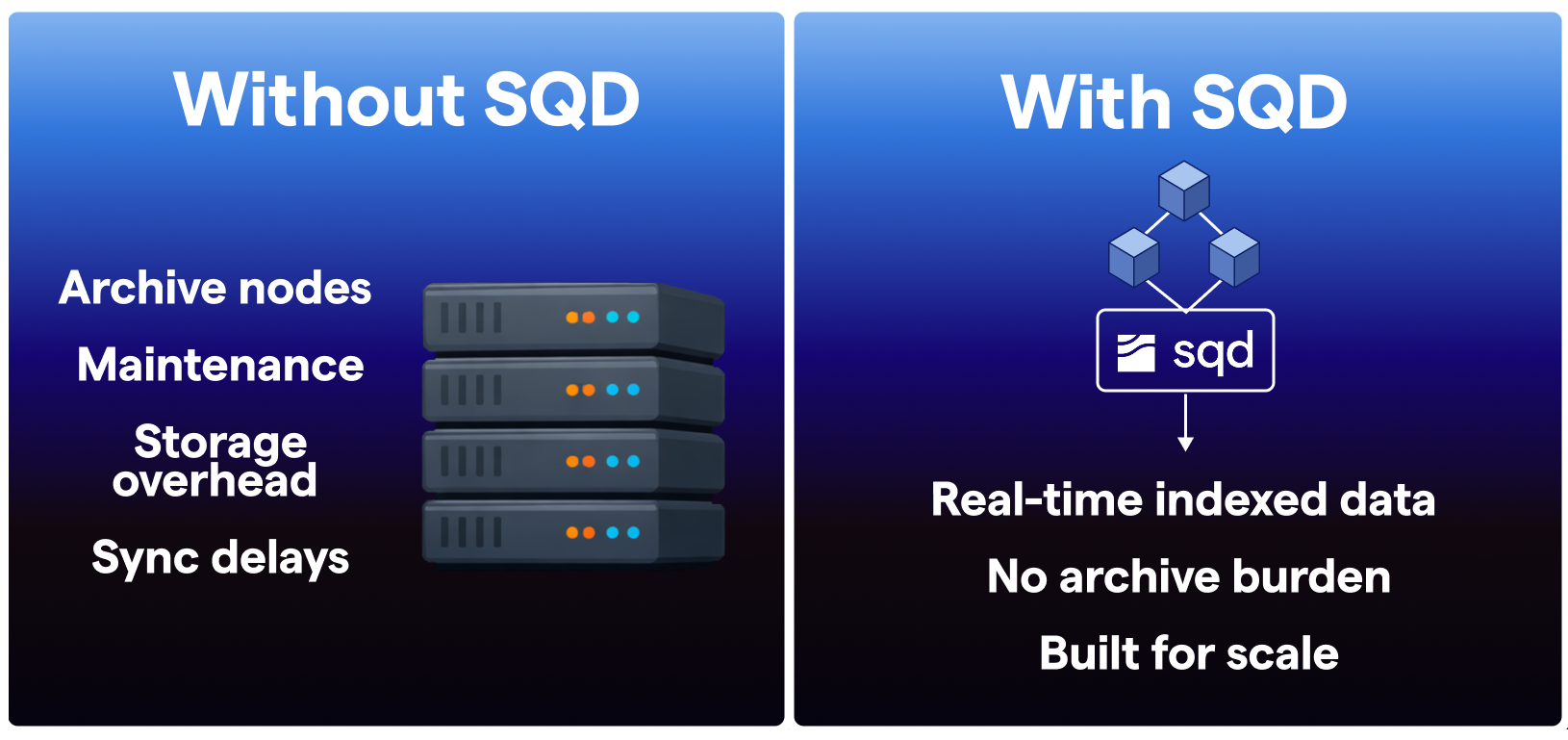
When you’re processing proof-scale volume, the wrong indexing approach forces you into expensive infra decisions (archive nodes, constant tuning, endless RPC pressure).
zkVerify’s goal was simple: real-time access, efficient batch processing, and predictable performance - even under load.
SQD matched that operating reality.
Bonus: a developer-friendly GraphQL layer
Once the data is indexed, teams still need to use it across products, dashboards, and tooling. SQD’s GraphQL serving options fit neatly into that workflow.
Integration
zkVerify adopted SQD early - before they had to “unwind” a legacy data setup - which let them architect the data layer around SQD’s capabilities from the start.
The main challenge wasn’t plugging SQD in. It was modeling zkVerify’s specialized structures correctly:
- proof verification events
- cross-chain attestation flows
- verifier pallet interactions
zkVerify built:
- custom processors for verifier pallets (to decode and index proof-specific metadata)
- custom handlers for cross-chain attestation events
And importantly, they called out the SQD team’s role in shaping schemas for performance - not just correctness:
“The SQD team provided excellent guidance on structuring our schemas to optimize query performance.”
Results
1) Real-time data access without expensive archive nodes
“SQD has enabled us to deliver real-time data access without running expensive archive node infrastructure ourselves.”
An operational simplification win.
2) Batch processing that holds up under proof-scale throughput
“The batch processing approach handles our proof verification throughput efficiently, even during high-activity periods.”
This is the kind of line you only get after you’ve been through the “high-activity period” and didn’t fall over.
3) Service quality stays high because visibility stays high
SQD powers zkVerify’s internal monitoring and KPI tracking, giving them clear sightlines into network activity and verification throughput - which helps them detect issues quickly and maintain reliable service levels.
What This Unlocks for zkVerify
Once the data layer becomes reliable and queryable, you stop building “just enough monitoring” and start building real product surface area:
- verifier pallet usage analytics (what’s actually being used, and how)
- cross-chain attestation tracking dashboards (attestations that don’t disappear into the multi-chain void)
- ecosystem health monitoring tools (what’s happening across activity, throughput, and patterns)
And because zkVerify is expanding attestation support over time, modular data pipelines matter:
“We can add new data sources and chain integrations without overhauling our indexing infrastructure.”
SQD Support
zkVerify’s feedback here was unambiguous: responsive, technical, and fast-moving.
“The SQD team has been highly responsive and technically proficient… They understand the unique challenges of Substrate-based chains.”
And the key line for any team on a launch clock:
“Quick turnaround on technical questions allowed us to move fast during development and resolve issues before they impacted our launch timeline.”
Conclusion: when verification is the product, the data layer can’t lag
zkVerify is building a modular proof verification layer designed to make verification more accessible and universal.
They support a broad set of proof systems - and that breadth only matters if the system remains observable, debuggable, and scalable as throughput grows.
They chose SQD because they needed:
- native Substrate indexing that doesn’t fight them
- custom schemas for domain-specific verification + attestation data
- throughput efficiency under high-activity periods
- monitoring-grade reliability, not “demo-grade” indexing
- a partner team that helps them ship faster
Or in their words:
“SQD delivers on performance, flexibility, and developer experience.”
If you’re building anything with high-volume, domain-specific data that generic indexers struggle to model - SQD is built for that. Feel free to reach our to Konstantin our Partnership Lead via k.kalinin@sqd.ai or Telegram @xyz_konstantin.